Jump to heading 5.Basic Area Formulas
Jump to heading
- Application
When the base and height are known, this formula can be used to calculate the area.
Jump to heading
Angle-sine Chart
1 Application
When two sides and the angle are known, this formula can be used to calculate the area.![]()
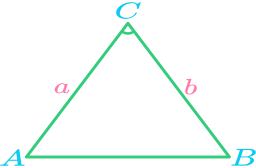
Jump to heading
- Application
When the three sides of a triangle are known, this formula can be used to calculate the area.![]()
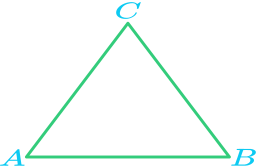
Jump to heading 6.Focus 3
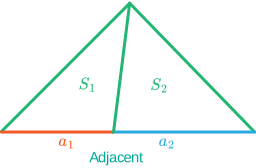
Use the relationship between base and height to calculate area.
- When two triangles have the same height, the ratio of their areas is equal to the ratio of their bases.
![]()
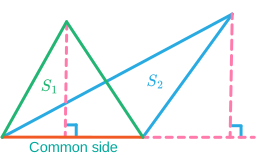
- When two triangles have the same base, the ratio of their areas is equal to the ratio of their heights.
![]()
- When two triangles have the same base and the same height, their areas are equal.
Jump to heading
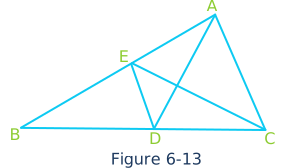
Jump to heading Solution
Show known conditions
![]()
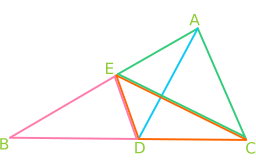
Solve according to the position of point D
Solve according to the position of point E
Jump to heading Conclusion
- Derived Solution
According to the Solution, get, so choose . - Formula used
Jump to heading
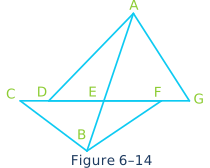
Jump to heading Solution
Show known conditions and assume that the unknown variable in the overall area
![]()
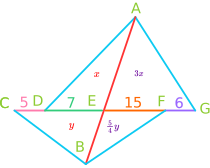
Jump to heading Conclusion
- Derived Solution
According to the Solution, get, so choose . - Formula used
Jump to heading 7.Focus 4
Using angle to solve an area.
- We know two sides and the angle between them in a triangle, can use the formula to solve the area
, need to memorize the trigonometric values for common angles.
Jump to heading
Jump to heading Solution
Jump to heading Conclusion
- Derived Solution
According to the Solution, get, so choose . - Formula used
Jump to heading
Jump to heading Solution
Jump to heading Conclusion
- Derived Solution
According to the Solution, get, so choose . - Formula used
Jump to heading 8.Focus 5
Given the three sides, use Heron's formula to find the area.
- When the three sides of a triangle are known, you can find the area using the formula
, where .
Jump to heading
Jump to heading Solution
Jump to heading Conclusion
- Derived Solution
According to the Solution, get, so choose . - Formula used
Jump to heading 9.Area of Special Triangles
Jump to heading
- Pythagorean theorem
. - Commonly used pythagorean numbers
, , , , , . - The scaled pythagorean theorem
.
- The scaled pythagorean theorem
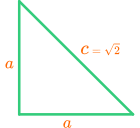
- The ratio of the three sides of an isosceles right triangle is
. ![]()
- The area of an isosceles right triangle is
, where is the length of the right angle side, and is the length of the hypotenuse. Jump to heading In a triangle with angles
, the sides are always in the ratio . ![]()
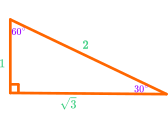
Jump to heading
- The ratio of the height to the side of an equilateral triangle is
. Jump to heading The area of an equilateral triangle is
, where is the length of the side.
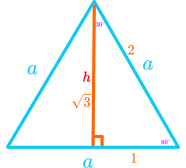
Jump to heading 10.Bird's Head Theorem
- Two triangles are called congruent-angle triangles if they share an equal or supplementary angle.
- Their area ratio is the same as the ratio of the products of the sides around those angles.
- Figure 6–11, in
and , the sine of is the same (same angles), so . ![]()
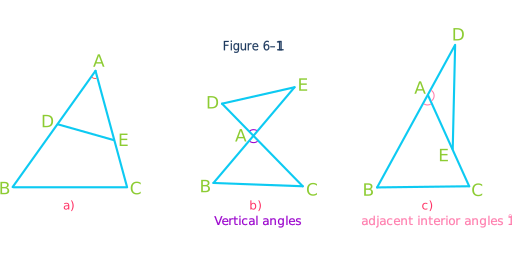
Jump to heading 11.Focus 6
Solve area using the Bird's Head theorem.
- When two triangles share a common angle or have equal angles, the Bird's Head theorem can be used: the ratio of their areas is equal to the ratio of the products of the sides adjacent to the corresponding angles (whether the angles are equal or supplementary).
Jump to heading
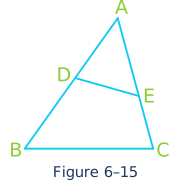
Jump to heading Solution
Show known conditions
![]()
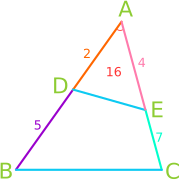
Jump to heading Conclusion
- Derived Solution
According to the Solution, get, so choose . - Formula used
Jump to heading
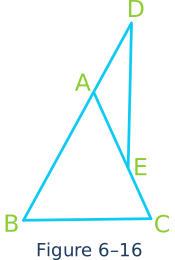
Jump to heading Solution
Show known conditions
![]()
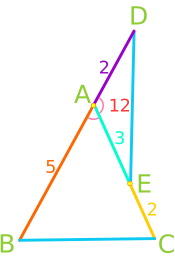
Jump to heading Conclusion
- Derived Solution
According to the Solution, get, so choose . - Formula used
Jump to heading 12.Swallowtail Theorem
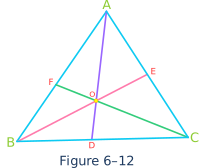
- Figure 6–12, within triangle
, the lines are concurrent at point , then . ![]()
- This theorem provides a new method for converting an area ratio into a segment ratio, because the shapes of
and resemble a Swallow's tail, the theorem is known as the Swallowtail Theorem. it is widely applied in various geometric problems; its particular significance lies in the fact that it can exist within any triangle, offering a way to relate the areas of sub-triangles to the corresponding segments on the base. - Derivation process: Since
and have equal altitude.
Jump to heading 13.Focus 7
Solve area using the Swallowtail theorem (equal altitudes).
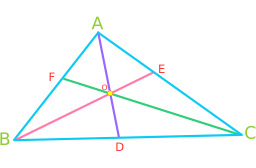
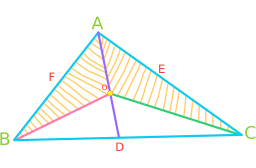
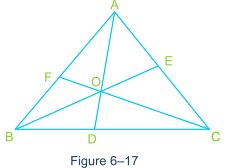
- When a point inside a triangle is joined to each of the triangle's vertices, the Swallowtail theorem can be applied for analysis.
![]()
- Formula derivations
![]()
Jump to heading
Jump to heading Solution
Show known conditions
![]()
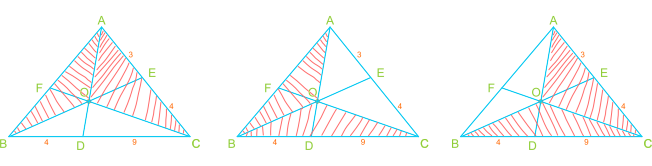
Jump to heading Conclusion
- Derived Solution
According to the Solution, get, so choose . - Formula used
| Platforms | Courses | Coursewares |
|---|---|---|
| YouTube | Watch | Courseware |
| Dailymotion | Watch | |
| Rumble | Watch |